
According to an article in This is Money, the war with Iran could create a little-known economic condition that may affect millions of UK households. While ‘stagflation’ might not be something you’ve heard of, it’s appearing more often in media headlines as the Iran war heads into its fourth month.
According to the article, high street bank, NatWest, expects inflation to peak at more than 3.5% in 2026, while economic growth slows to 0.4%. The warning came just days after Lloyds said the Iran war could result in ‘stagflationary consequences’ that could last into 2027.
So, what is stagflation and what could it mean for you and your wealth? Read on to learn more, and find out how you may be able to protect your money from its effects.
Stagflation is an economic rarity
The best way to explain stagflation is to think of the word as two halves. ‘Stag’ refers to a stagnant economy, and ‘flation’ refers to inflation.
Inflation measures the rising cost of living, and typically rises when the economy is doing well as people have more money to spend, and have the confidence to buy. This drives up demand, which pushes up the price of goods and services, causing inflation to rise.
While low levels of inflation signal a healthy economy, it can be damaging if it becomes too high. One reason for this is that the cost of raw materials goes up, which pushes up production costs and reduces business' profits.
When the economy suffers a downturn, consumers don’t normally have the money or the confidence to spend as much, meaning inflation typically falls. With stagflation however, you have higher levels of inflation at the same time as a stagnating economy.
Stagflation could reduce your wealth’s value in real terms
As you can see, the key driver of stagflation is higher levels of inflation, which decreases the value of your money in real terms over the long term. To demonstrate this, you may want to consider the Bank of England’s inflation calculator, which reveals that you needed £179.10 in March 2026 to have the same spending power of £100 in March 2006.
This means your money needed to grow by more than 76% during the 20-year period just to keep pace with inflation. If it didn’t, your money would have been dropping in value in real terms.
Investing may help protect your wealth from stagflation’s effects
One way you might be able to combat this is to consider investing your money, as historically, the stock market has tended to provide greater long-term growth potential than cash savings. To illustrate this, you might want to consider the following graph, which shows the performance of global equities and a medium risk 60:40 multi-asset portfolio between 1 January 2005 and 31 December 2025.
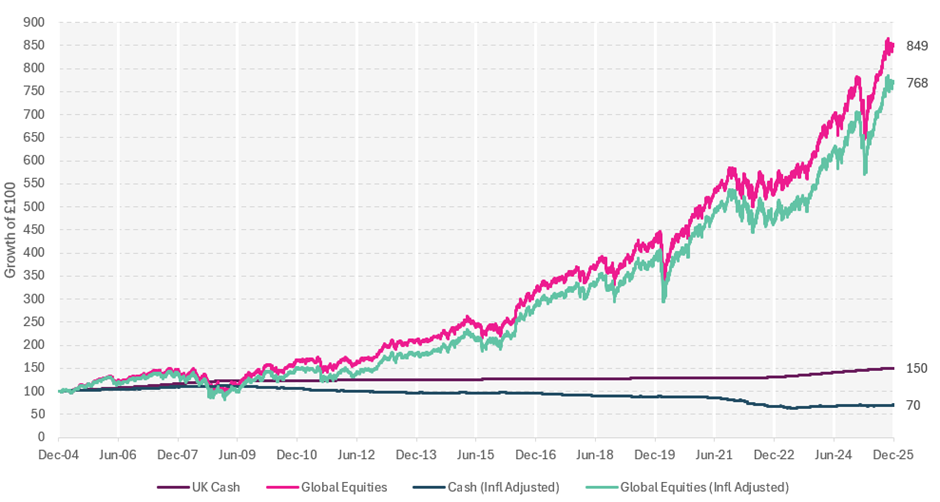 Data sourced from Morningstar by AFH Wealth Management. The 60:40 portfolio allocates 60% to MSCI ACWI and 40% to Bloomberg Global Aggregate.
As you can see, the multi-asset portfolio provided significantly higher levels of growth than cash savings did during the period, even when inflation was considered. Always remember that investing carries risk, and past performance is no guarantee of future performance. You may receive less than you originally invested.
A financial adviser will help you to understand the risks involved with investing, and whether it is likely to be the right option for you.
Get in touch
If you would like to discuss ways you could protect your wealth from stagflation or would like to arrange a no obligation meeting with one of our advisers, please call us on 0333 010 0008 and we’d be happy to help.
21 May 2026