
You may already know that Friday 14 August is Financial Awareness Day. The international awareness day aims to educate people around the globe on how to manage money more effectively.
This could help them to enjoy greater peace of mind in the short term and build financial security in the long term, so that they can look forward to a brighter tomorrow. As one of the UK’s leading independent financial advice companies, we understand the importance of demystifying the complex world of wealth management.
Central to this is helping people understand the questions they can ask themselves to get more from their wealth, and create a financial safety net. As financial education underpins everything we do at AFH Wealth Management, we have compiled five powerful questions that can help people to identify opportunities and risk to their wealth.
While many readers will be clients of AFH, and therefore worked through the questions already, we would be delighted if you shared the following with someone you feel would benefit from them.
1. What are my financial goals?
If you want to meet a goal, regardless of what it is, having a plan to achieve it can dramatically increase your chances of success. This is especially true when it comes to your personal finances, as identifying your objectives and having a strategy provides clarity over the long term.
Additionally, having a plan can help to keep you on track if you’re tempted to spend your money on something that may bring short-term satisfaction, yet jeopardise your long-term ambitions. That said, your plan shouldn’t be inflexible as you may need to change it if something unexpected happens – whether good or not so good.
This might include, for example, getting married or divorced, achieving a major promotion, having children, or being made redundant.
2. Is my money working as hard as it can?
According to research by JP Morgan in June 2025, UK households are ‘over-reliant’ on cash savings. The study revealed that since the Covid epidemic in 2020, Britons had squirrelled away £870 billion in cash savings by 2025.
While on the face of it this is good, there could be a catch: having some cash in an ‘emergency fund’ is good, but too much cash could devalue your money’s value in real terms because of inflation.
To demonstrate the effects of inflation on money, you might want to consider the Bank of England’s inflation calculator. It reveals that you needed £177.79 in May 2026 to have the same spending power of £100 in 2006, meaning your money had to grow by 77% just to keep pace with the rising cost of living.
Without this growth, your money would have dropped in real-term value. There is some good news though, as you may be able to inflation-proof your cash by investing it. Historically, shares have tended to provide greater growth potential than cash savings, something the following illustration shows.
It reveals the performance of cash, compared to the performance of global equities and a medium risk 60:40 multi-asset portfolio between 1 January 2005 and 31 December 2025.
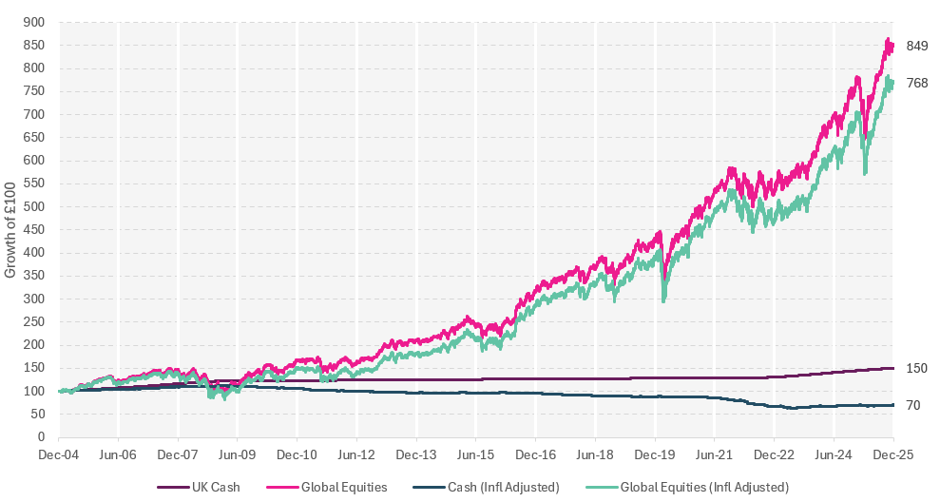 Data sourced from Morningstar by AFH Wealth Management. The 60:40 portfolio allocates 60% to MSCI ACWI and 40% to Bloomberg Global Aggregate.
As you can see, the multi-asset portfolio provided significantly higher levels of growth than cash savings did, even when inflation is considered. Always remember that investing carries risk, and past performance is no guarantee of future performance. You may receive less than you originally invested.
3. Are my finances protected from unexpected events?
Life tends to throw a curve ball from time to time, which can seriously jeopardise your financial stability. For example, if you weren’t able to work due to an accident or illness, your income could drop significantly, or worse still, disappear.
If you die and have loved ones who are financially dependent on you, they may struggle to maintain their lifestyle without you. As a result, they may even have to sell the family home.
Protecting your life, and your income, could ensure you and your loved ones are financially secure no matter what the future holds.
4. Am I budgeting correctly?
Budgeting is the foundation of good financial practice. Fundamentally, it helps you to track and control your spending, to ensure you don’t inadvertently spend more than you have and end up with uncontrollable debt.
It’s important to remember that inflation means the amount you need to support your lifestyle goes up over time. This is why regularly adjusting your budget means you will have a clearer idea of how much disposable income you have even after prices have risen.
This could help ensure you don’t accidentally overspend and end up relying on a loan or credit card to maintain your lifestyle, which could mean paying expensive interest rates.
5. Is my wealth as tax efficient as possible?
While it’s important to remember that financial advisers are not tax experts, they have a good working knowledge of the latest tax rules. As such, they can help you identify ways that you could reduce your exposure to a variety of taxes, which could mean you keep more of your income and wider wealth.
This might include, for example, using tax-efficient ISAs to help shield any growth your money enjoys from Capital Gains Tax, Dividend Tax or Income Tax. Alternatively, you might want to consider using pension savings to reduce your exposure to Income Tax or National Insurance Contributions (NICs).
If you would like to consider ways to reduce your wealth’s exposure to tax, including Inheritance Tax, speaking to a financial adviser is often a very good strategy. They can explain using clear and simple language how you could get more from your money, and the risks that may be involved.
How can AFH help?
If you would like to discuss your wealth, and how we may be able to help you get more from it and protect it, please call us on 0333 010 0008 to arrange a no obligation initial meeting with one of our independent financial advisers.
Alternatively, please download our informative ‘simple and effective ways to create a financial roadmap’ guide, which is full of useful tips.
5 August 2026