
It’s fair to say that we’re living in an increasingly uncertain world. If you look at the media, you’ll see the International Monetary Fund (IMF) is worrying about the level of debt within the world’s biggest economies, as well as the impact AI could have on jobs around the globe.
With all this uncertainty, and its possible impacts on the stock market, you might be wondering how you can increase your financial resilience. The good news is that there are simple, yet effective steps you can take that could help you weather a financial storm.
Read on to discover three you may want to consider.
Review your protection needs
Being diagnosed with a serious illness that means you’re unable to work is probably something many of us would rather not think about. That said, if it were to happen, it could jeopardise your financial security and result in you having to reduce your standard of living.
Additionally, if you’re off work for an extended period you may have to pause your pension contributions, which could have implications for your retirement lifestyle. The good news, however, is that you could protect your earnings, or receive a cash lump sum to support yourself financially, if you’re diagnosed with a serious illness.
Taking financial protection could remove the stress caused if your income dries up at a time you’re trying to recover from a serious illness. It could also help ensure you can support your standard of living and sidestep the need to rush back to work before you’re fully recovered due to financial pressure.
As such, having protection could provide your wealth with the resilience to withstand life’s unexpected events, which could include a serious illness or death in the family.
Top up your emergency fund
Having an adequate emergency fund is central to financial resilience. It allows you to deal with life’s unexpected (and potentially expensive) events without having to rely on credit cards or a loan.
Furthermore, it means you won’t have to sell your investments, which could put your future financial security at risk.
Whether you use your emergency fund to deal with a significant bill, such as major work on your home, or to support yourself should you lose your job, the importance of a ‘rainy day’ fund cannot be overstated. It’s usually recommended that you keep three to six months’ worth of expenses in your fund, which should also be kept in an easy to access savings account.
All that said, as it’s in cash savings, you should always keep in mind inflation, and the possible effects it could have on your fund. To demonstrate the impact inflation may have, you might want to consider the Bank of England (BoE) inflation calculator.
It reveals that if your outgoings were £4,000 a month in 2020, the same standard of living would cost more than £5,100 in August 2026. If you saved £12,000 expecting this to last you three months, you could have a shortfall of almost £3,300.
For this reason, topping up your emergency fund to ensure it doesn’t lose spending power could be key in maintaining your financial resilience.
Check your investments are diversified
Historically, investing has tended to provide greater growth potential than cash savings. To show this, you might want to consider the following illustration, which shows the performance of global equities and a medium risk 60:40 multi-asset portfolio between 1 December 2006 and 1 September 2026.
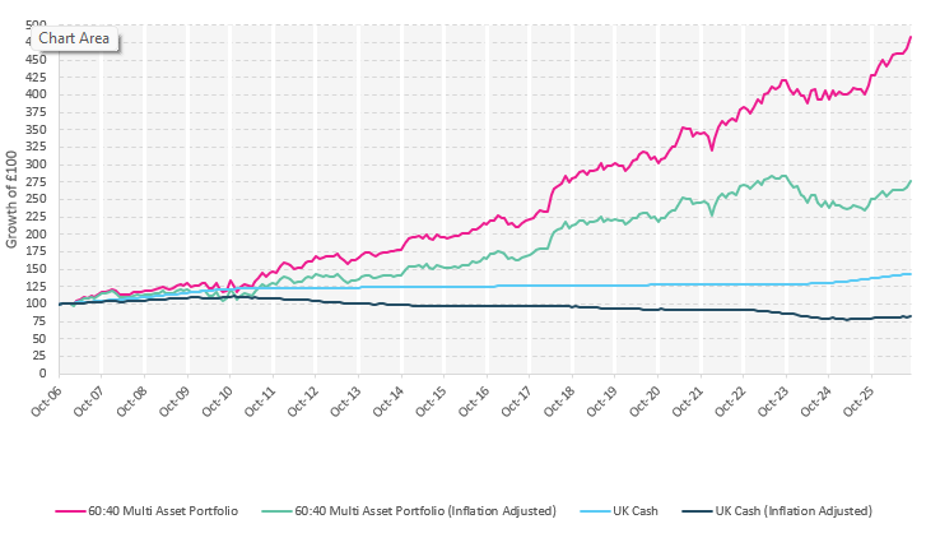 Data sourced from Morningstar by AFH Wealth Management. The 60:40 portfolio allocates 60% to MSCI ACWI and 40% to Bloomberg Global Aggregate.
As you can see, the investment portfolio provided significant returns over the long-term when compared to cash savings, including when inflation is considered. While this is why investing is typically included in a wealth plan, global events can result in stock market turmoil, which could result in your investments dropping in value.
It’s important to remember that you’re more exposed to market downturns if your investments are too concentrated in one area. For example, if most of your money is in tech stocks, your investments could suffer a greater downturn if the industry faces difficulties.
If, on the other hand, you spread your investments across different industries, sectors, and geographical regions, you may see growth in some stocks while experiencing losses from others.
As a result, your gains could help to balance out the losses, meaning the overall fall in your portfolio is substantially reduced. Better still, it may mean your portfolio enjoys greater growth potential over the long term.
This is why ensuring your investments are diversified over different industries, sectors, and geographical regions is a wise move.
How can AFH Wealth Management help?
As one of the UK’s leading independent financial advice companies, we understand the importance of creating a financial plan that includes resilience. If you would like to discuss your financial resilience, and how you might be able to boost it, please call us on 0333 010 0008.
Alternatively, use the following link to arrange a no obligation initial meeting with one of our independent financial advisers.
20 October 2026