
As the situation in the Middle East continues to unfold, the severity of the situation cannot be overstated. On a humanitarian level, the lives of many civilians across the globe are under threat.
On an economic level, the impact of rising oil prices and the disruption in the Strait of Hormuz, a critical thoroughfare for global maritime trade, could result in a hike in energy prices across the world. In addition to this, the Iran conflict with the US means uncertainty has returned to the stock market.
Since it began on Saturday 28 February, the stock market has, broadly speaking, suffered a downturn. If you have investments, you might be wondering what this could mean for your money, and how best to weather the storm.
If you are, read on to discover three actions you could take to take to help you achieve your long-term investment goals.
1. Avoid any kneejerk decisions to sell
Historically, the stock market has gone up and down. Experienced investors know this and tend to see downturns as part of the natural ebb and flow of the markets.
As such, they are less likely to respond to a downturn with a kneejerk reaction to sell, as they understand this could be a decision they later regret. This is because selling your investments usually turns a paper loss into an actual one and denies your money any chance of recovery when the stock market later rallies – which it has historically tended to do.
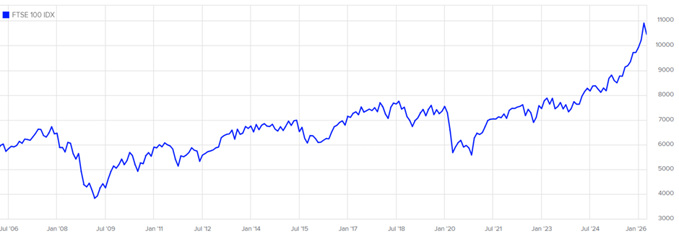
Over the years there have been countless wars, crises and market-impacting geopolitical events, such as the Covid pandemic, Brexit and the great recession of 2008. Despite this, stocks and shares have tended to rise over the long term, which is highlighted in the following illustration.
It shows the performance of the FTSE 100 between February 2006 and February 2026.
Source: London Stock Exchange
As you can see, over the long term, the index rose significantly in value, despite major downturns due to the 2008 financial crisis, Brexit and Covid. If you had sold your investments during these downturns and switched to cash, you would have locked in the losses and missed out on the growth potential that followed.
Please remember that past performance is no guarantee of future performance.
2. Avoid checking on your investments every day
It can be extremely tempting to check on your investments on a daily basis when the stock market is volatile. While understandable, seeing the value of your investments go down could spook you into a decision you bitterly regret later on.
Remaining calm and avoiding this temptation is usually the better strategy, as it means you’re likely to remain invested. This in turn means you’re more likely to see your wealth grow further down the line.
This is backed up by an article in IFA magazine, the national publication for professional financial advisers, which shows that analysis of US military conflicts since World War II revealed equity markets typically experience short-term volatility that is then followed by recovery. The article pointed to data which revealed that, in most cases, the S&P 500 posted positive returns within three, six, and twelve months of a US overseas military strike. On average, the article goes on to explain, the markets had risen by 12–13% one year later, despite initial downturns averaging around 11-12%.
As such, remaining calm and avoiding the temptation to constantly check your investments means you’re more likely to remain invested. This is likely to be a much better approach over the long term.
3. Consider investing more of your wealth
When the markets become volatile, social media and the news typically focus on the negatives, instead of the potential opportunities it could provide. This focus on the negative implications of a stock market downturn causes a lot of discomfort for many investors, who then decide to sell in a bid to limit losses.
As a result, the stock market drops in value, and while you might assume investing at a time like this might be something you would want to avoid, the reality could be very different. Investing when values have fallen means your money buys you more, giving your investments greater long-term growth potential.
Consequently, your wealth could be provided with a significant boost when the market recovers, which is why one of the world’s most successful investors, Warren Buffet, said:
“Be fearful when others are greedy, and greedy when others are fearful”.
Investing during these uncertain times could be something you want to consider. That said, you should always speak to a financial adviser before doing so, as they can ensure it’s the best option for you and explain the risks involved.
Get in touch
We understand that the Iran conflict could make investors, or those considering investing, nervous. If you would like to discuss your investments, or whether now might be a good time to invest, please contact us on 0333 010 0008.
We’d be happy to arrange a no-obligation initial meeting with one of our independent financial advisers.
11 March 2026