
According to the World Animal Foundation in January 2026, there are around 13.5 million pet dogs in the UK, with nearly a third of Britons (30%) having one or more canine companions. Perhaps it’s not surprising when you consider research that suggests walking man’s best friend is not only enjoyable, it’s good for you.
According to Purina, 82% dog owners believe walking their beloved pooch improves their mental health as it provides an opportunity to escape the pressures of daily life. And now that the clocks have gone forward and the evenings are lighter, it’s an ideal time for dog owners to get out and enjoy some down time with their pet.
If you’re a dog owner and an investor, however, there are surprising similarities between walkies with your faithful friend and getting the most from your investments. Read on to discover more.
Sometimes, walking your dog involves a leap of faith
For the object of the exercise, imagine walking your four-legged friend through the countryside, during which you arrive at a field. You enter it through a gate, and see a path that leads to a second gate on the far side of the field.
After checking there’s no livestock, you unclip your dog’s lead, at which point your beloved hound goes into freestyle mode. You watch it as it races ahead, zig zagging back and forth across the path as it picks up interesting scents.
Not long after, it disappears into the hedgerow surrounding the field, and despite you calling it and trying to entice it back with its favourite treats, there’s no sign of your pet. On the face of it things are not going to plan.
If you’re a new dog owner, you may be alarmed by your dog’s waywardness. If it vanishes for what feels like a long time, you may begin to fear the worst and rush home print ‘lost’ posters to put on lampposts.
As you dash home you start making plans in your head to call the local dog rehoming centres and drive around the neighbourhood looking for your beloved pet. More often than not though, your fears will amount to nothing.
Soon after exiting the field your faithful friend suddenly appears, tail wagging after it’s mini-adventure.
If you’re an experienced dog owner, on the other hand, it’s likely that you’ll be far more relaxed about your dog disappearing for an extended period. Years of walking Fido means you know that the best course of action is to remain calm and carry on walking towards the gate on the other side of the field.
Usually, remaining relaxed and continuing as planned means you enjoy your stroll, and your wayward hound reappears as hoped, tail wagging and ready to go back on the lead.
This is why investing is like walking your dog
While it’s not immediately obvious, the above scenario is an excellent metaphor for successful investing. If you start with walking through the gate with your four-legged friend, this could be seen as your initial investment.
The gate on the opposite side of the field represents your financial goal. If you think of the field as the stock market, then your wayward dog zig-zagging across the field and reflects the ebb and flow of investments.
Them disappearing and refusing to return could provide the same sense of frustration and stress as seeing the market suffer a significant downturn. In the same way an experienced dog walker knows it’s typically best to remain calm and carry on, experienced investors know this is the best approach when dealing with the stock market.
This is because it’s always moving, and an experienced investor knows that over the short term, investments go up, and investments go down. Everyone who invests their money should expect downturns at some point, and potentially major ones, especially when geopolitical events and the financial headlines are particularly dramatic.
Historically, however, the stock market has tended to rise over the long term, something illustrated by the following graph, showing the performance of the FTSE 100 between March 2001 and March 2026. The index tracks the performance of the largest 100 companies listed on the London Stock Exchange.
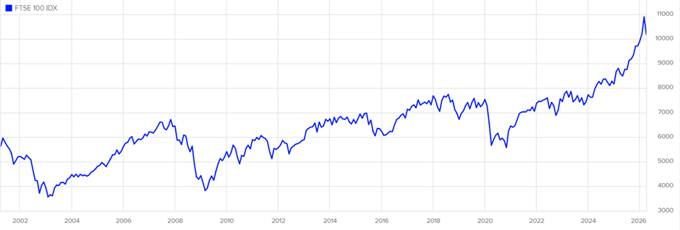
Source: London Stock Exchange
As you can see, while the index experienced significant downturns over the 25-year period, overall it has increased in value. This is why experienced investors tend to ignore short-term drops in value, and instead remain calm and focused on their long-term objectives.
Investors that become alarmed and make a knee jerk reaction to exit the market in the hope of limiting losses, usually turn a paper loss into a real one. Furthermore, they deprive their money of future growth potential when the market recovers.
All that said, please remember that previous performance is no guarantee of future performance, and you may receive back less than your original investment.
Get in touch
If you would like to discuss whether investing might help you to achieve your long-term financial goals, please contact us on 0333 010 0008. We’d be happy to arrange a no-obligation initial meeting with one of our Independent Financial Advisers.
10 April 2026