
Buying presents for teenagers can be tricky, which is why you may have decided to give them cash this Christmas. Doing so means they can buy exactly what they want, but it also helps them to understand the importance of saving up or waiting for life’s nice-to-haves.
Understanding this means they’re much less likely to use expensive credit or loans to buy what they want later in life, instead of saving up for it. If younger members of your family have money left over after buying their desired item, the cash that’s left could be used for another powerful financial lesson: investing might be a shrewder financial strategy than cash savings.
Read on to discover more, and why a Stocks and Shares Junior ISA (JISA) could give the teenager’s Christmas cash a significant boost.
1. Investing could offer greater growth potential
Historically, the stock exchange has tended to provide greater growth potential than cash savings over the long term. To demonstrate this, you might want to consider the following graph, which tracks the performance of a medium risk 60:40 multi-asset investment portfolio between 1 January 2005 and 1 July 2025.
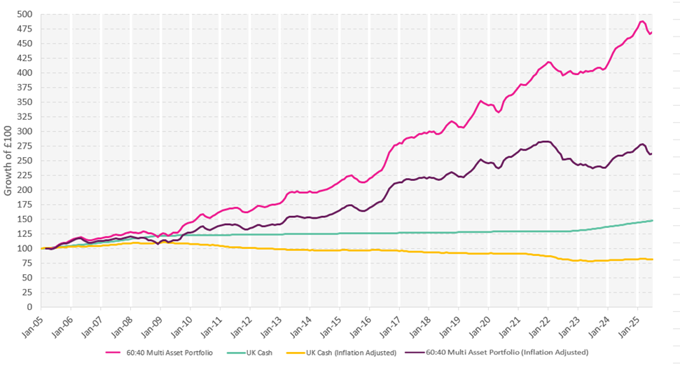 Data sourced from Morningstar by AFH Wealth Management. The 60:40 portfolio allocates 60% to MSCI All Country World Index (ACWI) and 40% to Bloomberg Global Aggregate.
As you can see, the investment portfolio (pink line) provided significant returns over the long-term when compared to cash savings (green line). Furthermore, the illustration highlights that this is still the case after inflation is considered.
Inflation measures the rising cost of goods and services over time, which means it decreases the spending power of cash over the long term. As such, the real value of cash savings can actually go down, as highlighted by the yellow line.
Yet even after inflation, the illustration reveals that investments grew in value (purple line). This means investing could help to inflation-proof money, which could help younger members of your family future proof their wealth from the rising cost of goods and services.
Always remember that past performance is no guarantee of future performance, and you may receive back less than you originally invested. The returns illustrated are the result of cash being invested meaning capital is at risk.
2. It teaches them to understand, and manage, risk
As the above sentence points out, investing always carries an element of risk. This is because an investment’s long-term growth typically comes from assets that are more likely to suffer short-term, or even total losses, such as Stocks and Shares.
Similarly, assets that are less prone to short term losses will typically expose money to lower levels of growth over the long term. Helping younger members of your family understand how risks works and how to manage risk more effectively could ensure they invest appropriately later on.
As a result, they’re more likely to make better choices around how their money is invested, which could enhance future growth potential and ensure the money is exposed to the right level of risk.
3. With a Stocks and Shares Junior ISA, there are tax benefits too
There are two types of Junior ISAs (JISA), a Cash JISA and Stocks and Shares JISA. These tax-efficient accounts can be opened by a parent or legal guardian for anyone under the age of 18 as long as the youngster doesn’t have a child trust fund.
Anyone can pay into the JISA and the child is legally entitled to control the assets within it when they reach the age of 16. They cannot, however, draw any money from it until they are 18 years old.
By including the teenager in conversations and decisions about the Stocks and Shares JISA before they have a legal right to it, they will be better placed to make good decisions when they take it over.
In 2025/26, you can place up to £9,000 per child into a JISA, and like adult ISAs, any money taken from a it is free from Income Tax. Furthermore, any growth or interest the JISA enjoys is exempt from Capital Gains Tax and Dividend Tax.
You can open a Cash and Stocks and Shares JISA for a child and then place money into both of them, as long as you don’t exceed the £9,000 limit. It’s worth noting that any money that’s gifted into a JISA cannot be withdrawn or returned.
Working with a financial adviser could help
Investing should never be entered into lightly, which is why you should always speak to a financial adviser if you’re considering opening a JISA. If you already have a financial adviser, you might want to consider including your teenage child or grandchild in part of the conversations you have.
This is because financial advisers are used to explaining the complex world of investing using clear and jargon free language, meaning they can help to remove the mystery around it. This in turn means the teenager could gain a deeper understanding of investing, as a result they’re more likely to make decisions they’ll thank themselves for later on.
Get in touch
If you would like to discuss opening a Stocks and Shares JISA for your child or grandchild, please contact us on 0333 010 0008. We would be happy to arrange a no obligation initial meeting with one of our independent financial advisers.
22 December 2025