
As the Iran conflict rages on, the word ‘Trumpflation’ is increasingly appearing in media headlines. The term refers to the rising cost of goods and services as a result of President Trump’s decision to go to war with Iran, which has sent oil and gas prices spiralling.
According to the Guardian, ‘Trumpflation’ could result in new mortgages rising by an average of £800 a year by the end of 2026. This, it goes on to say, would be the biggest upheaval to mortgages since Liz Truss’s ‘disastrous mini-budget’ in 2022.
If the cost of goods and services continues to rise throughout the year, it could have a detrimental effect on your wealth. Read on to discover why this is, what it might mean for your money and how you may be able to protect your wealth from its effects.
‘Trumpflation’ could reduce your wealth in real terms
The ‘flation’ part of ‘Trumpflation’ refers to inflation, which measures the rising cost of goods and services over the long-term. As inflation measures the cost of goods and services including energy, food, clothing and even alcohol-free beer, it has the power to devalue your money in real terms.
This is because £100 is likely to buy you less in the future than it does today, meaning your cash is losing its spending power over time. To demonstrate this, you may want to consider the Bank of England’s (BoE) inflation calculator, which reveals that you’d have needed £174.43 in January 2026 to have the same spending power as £100 in January 2006.
As a result, your money would had to have grown by 74.4% just to keep pace with the rising cost of living. It’s worth bearing in mind that the average annual inflation rate for the period was 2.82%, which is lower than January 2026’s rate of 3%.
Lower levels of inflation are seen as the sign of a healthy economy, which is why the BoE aims to keep it at 2% or below. Higher levels of inflation, on the other hand, can be bad for the national economy because it has the potential to push up the price of raw materials, which then pushes up production costs and can reduce business’s profits.
Investing could help to inflation-proof your wealth
As mentioned earlier, inflation stood at 3% in January 2026, official data from the Office for National Statistics revealed. While it was expected to drop throughout the year, the effects of ‘Trumpflation’ means the opposite may now be more likely.
On Thursday 19 March, the BoE decided to hold interest rates at 3.75% instead of cutting them as predicted. According to the BBC, the bank’s said the conflict in the Middle East had resulted in a ‘shock to the economy’ that could push inflation up to 3.5% by the summer.
When it comes to your wealth, however, there may be some good news, as you may be able to inflation-proof your cash by investing it. Historically, the stock market has tended to provide greater long-term growth potential than cash savings.
To illustrate this, you might want to consider the following graph, which shows the performance of global equities and a medium risk 60:40 multi-asset portfolio between 1 January 2005 and 31 December 2025.
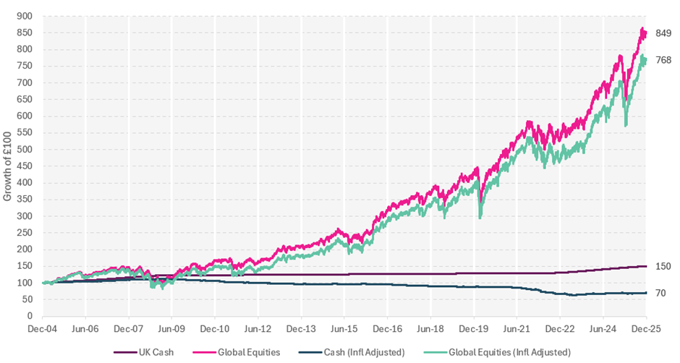
Data sourced from Morningstar by AFH Wealth Management. The 60:40 portfolio allocates 60% to MSCI ACWI and 40% to Bloomberg Global Aggregate.
As you can see, the multi-asset portfolio provided significantly higher levels of growth than cash savings did during the period, even when inflation was considered. As such, investing your wealth could help to inflation-proof it over the long term, and save it from the impact of ‘Trumpflation’.
Always remember that investing carries risk, and past performance is no guarantee of future performance. You may receive less than you originally invested. A financial adviser will help you to understand the risks involved with investing, and whether it is likely to be the right option for you.
Get in touch
If you would like to discuss whether investing could help to inflation-proof your wealth, and whether it’s right for you, please contact us on 0333 010 0008. We’d be happy to arrange a no-obligation initial meeting with one of our independent financial advisers.
24 March 2026