
While ‘sequence-of-returns risk’ may not be something you’ve heard of, the implications of it could well impact you. Put simply, it could make the difference between your pension pot providing the retirement lifestyle you want or not.
Often referred to a ‘sequence risk’, it’s triggered when the investments within your pension drop in value just as you start to take an income from it. As a result of this, your pension pot could run dry earlier than expected, which could mean you have to significantly reduce your standard of living.
Read on to discover more about sequence risk, and the steps you could take to reduce its impact on your retirement. Before you do however, we need to look at the relationship between investments and pensions.
Broadly speaking, pensions hold investments
If you have a defined contribution (DC) pension, otherwise known as a ‘money purchase scheme’, the contributions you make are placed into a range of assets, which can include:
- stocks and shares
- commercial property
- government bonds.
Stocks and shares are used to expose your pension pot to higher levels of growth over the long term. This is because historically, stocks and shares have tended to provide greater returns than cash, which ensures the money within your retirement fund maintains its spending power.
To demonstrate this, you might want to consider the following illustration, which shows the performance of a 60:40 multi-asset investment portfolio between 1 January 2005 and 1 July 2025. 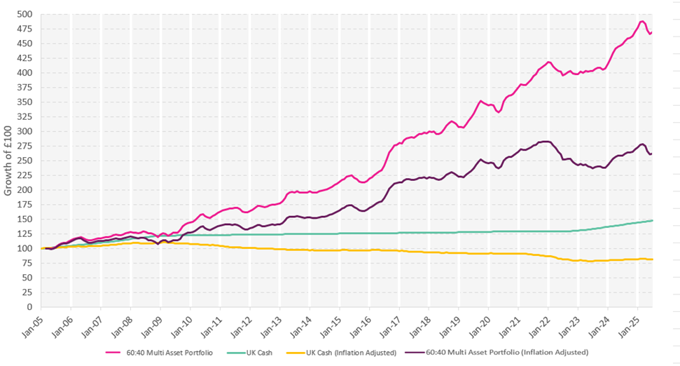
Data sourced from Morningstar by AFH Wealth Management.
The 60:40 portfolio allocates 60% to MSCI All Country World Index (ACWI) and 40% to Bloomberg Global Aggregate. This graph is for illustrative purposes only.
As you can see, the investment portfolio (pink line) provided significant returns over the long-term when compared to cash savings (green line). Furthermore, this is still the case after inflation is considered.
That said, the growth provided by stocks and shares carries risk. While they have the potential to grow significantly in value when the stock market’s rising, they can also drop substantially in value when it suffers a downturn.
If this happens and your pension’s value plummets when you first draw an income from it, sequence risk could become an issue. Please remember that historical returns are not a reliable indicator of future returns either.
Sequence risk could shrink the size of your pension pot
If, when you retire, the markets are rising, the amount you withdraw from your pension will be covered by the rising value of your shares. If, on the other hand, the markets are falling, the value of your shares could fall, meaning you’ll need sell more of them to generate the income you want.
In other words, the income shortfall will need to be covered by selling more of the capital within your pension.
As a result, you will be depleting the investments within your pension much more quickly than expected, which might mean it can no longer provide the income you need. Worse still, if you continue taking the income and capital needed to support your lifestyle in retirement, you could inadvertently deplete your pension pot much earlier than expected.
This could put your financial security at risk and may even mean you have to significantly reduce your standard of living later in life.
It’s not all bad news though, as there are steps you might be able to take to protect your pension from sequence risk if the markets take a downturn just as you retire. The following are three you might want to consider.
1. Defer retirement
If possible, deferring your retirement could be an extremely shrewd move. It allows the markets to recover, meaning your pension will not be affected by sequence risk when you access it.
Furthermore, you can continue to make contributions to your pension pot, which could boost its value and provide a higher standard of living when you stop working.
2. Live off other assets
If you have savings or other assets, such as investments, you might want to consider using these to draw an income when you first retire. Doing this preserves your pension pot and may give it the time needed to recover before you start to draw an income from it.
3. Consider an annuity
With an annuity, you exchange the value of your pension pot for a guaranteed income. This could be for the rest of your life, or for a set period of time.
As annuities are not affected by the stock market, your long-term income will not be impacted if the markets fall in the first few months of your retirement. This could provide peace of mind that you’ll receive the income you need to maintain your standard of living (as long as it’s inflation-proofed).
Watch our insightful webinar
If you’re approaching retirement, another important question you might be asking yourself is whether to opt for an annuity or flexi-access drawdown. To help you understand your options more clearly, we hosted our latest webinar that discussed both options in a clear and understandable way.
Join former BBC presenter Mark Foster and AFH’s Chief Advice Officer, Austin Broad, as they consider this important aspect of retirement planning.
To watch the event, titled: Securing your retirement income: annuities and drawdown explained, simply complete the form above.
Get in touch
If you’re approaching retirement and would like to understand your options, please contact us on 0333 010 0008 and we would be happy to arrange a no obligation initial meeting with one of our independent financial advisers.
26 January 2026